

Wood vs. gas fireplaces have different maintenance needs. Dallas's climate adds another layer most homeowners don't think about. Here's what the schedule actually looks like for your home.
Our mild winters mean fewer fires, but summer humidity quietly does damage inside your flue year-round. Whether you burn wood or run gas logs, the answer isn't the same.
Learn more about chimney repointing Dallas in Plano, TX →
Learn more about smoke chamber repair Dallas in Dallas, TX →
Dallas Homeowner Alert
Summer humidity causes mold inside flues even when you haven't lit a fire all season
Complete Frequency Guide
The National Fire Protection Association's NFPA 211 standard is the baseline. Here's how it applies to Dallas specifically.
Wood-Burning Fireplaces
Annual cleaning applies even if you only lit five fires all winter. The NFPA 211 standard calls for annual inspection and cleaning of all wood-burning systems, and there's a real reason behind it.
Creosote forms in three stages. Stage 1 is a light, flaky deposit that brushes off easily. Stage 2 is a harder, tar-like coating. Stage 3 is glazed creosote, which is shiny, nearly impossible to brush out, and a serious fire hazard. The transition from Stage 1 to Stage 2 can happen in a single season if conditions are right.
If you burn more heavily, say 80 or more fires between November and March, some homeowners in Dallas benefit from a mid-season inspection as well. A chimney sweep in Dallas can assess your creosote load after a few weeks of regular use.
Best Timing For Dallas
Gas Fireplaces and Log Sets
Gas appliances burn cleaner than wood, but they still need attention. The main threats aren't creosote. They're blockages, liner deterioration, and carbon monoxide risk.
Birds and squirrels nest inside unused flues every spring in Dallas. A gas fireplace that sat dormant from March to November can have a bird nest partially blocking the flue opening. Carbon monoxide has nowhere to go. That's a life-safety problem, not a cleanliness one.
A gas chimney inspection in Dallas also catches deteriorating liner tiles and failed mortar at flue joints, which become more common as Dallas clay soil shifts seasonally and puts stress on masonry structures.
Signs You Should Not Wait 2 Years
Dallas-Specific Warning
Burning wood from your own backyard sounds practical, but it accelerates creosote buildup significantly. Live oak and pecan are two of the most common trees in Dallas neighborhoods. Both are hardwoods, which is generally a good thing, but the problem is moisture content.
Freshly cut or "green" wood from a backyard tree typically has a moisture content above 45 percent. Kiln-dried hardwood sold by firewood suppliers runs 15 to 20 percent. When you burn high-moisture wood, incomplete combustion produces much more creosote, and that creosote condenses on cooler flue surfaces before it can exit the chimney. One cord of green live oak can produce as much Stage 2 creosote as three or four cords of properly seasoned firewood.
If you've burned backyard pecan or live oak this season, don't wait for your annual cleaning date. Check for creosote warning signs yourself, and schedule a sweep soon. The buildup may be heavier than a normal year of burning would produce. A camera inspection of your flue will show you exactly what you're dealing with.
45%+
Moisture in green backyard wood
15-20%
Moisture in kiln-dried hardwood
3-4x
More creosote from green wood
What the Work Covers
A standard sweep and inspection at Safe Flue typically runs two to four hours for a single-fireplace home. Here's what actually happens during that time.
The job starts outside. We check the chimney cap, crown, and visible masonry from the ground. In Dallas, the crown takes a beating from temperature swings. A 100-degree July followed by a 25-degree January night creates expansion and contraction that cracks crowns faster than in more moderate climates. Any damage to the crown or cap gets noted before we even go near the firebox. Learn more about chimney crown repair timelines in Dallas.
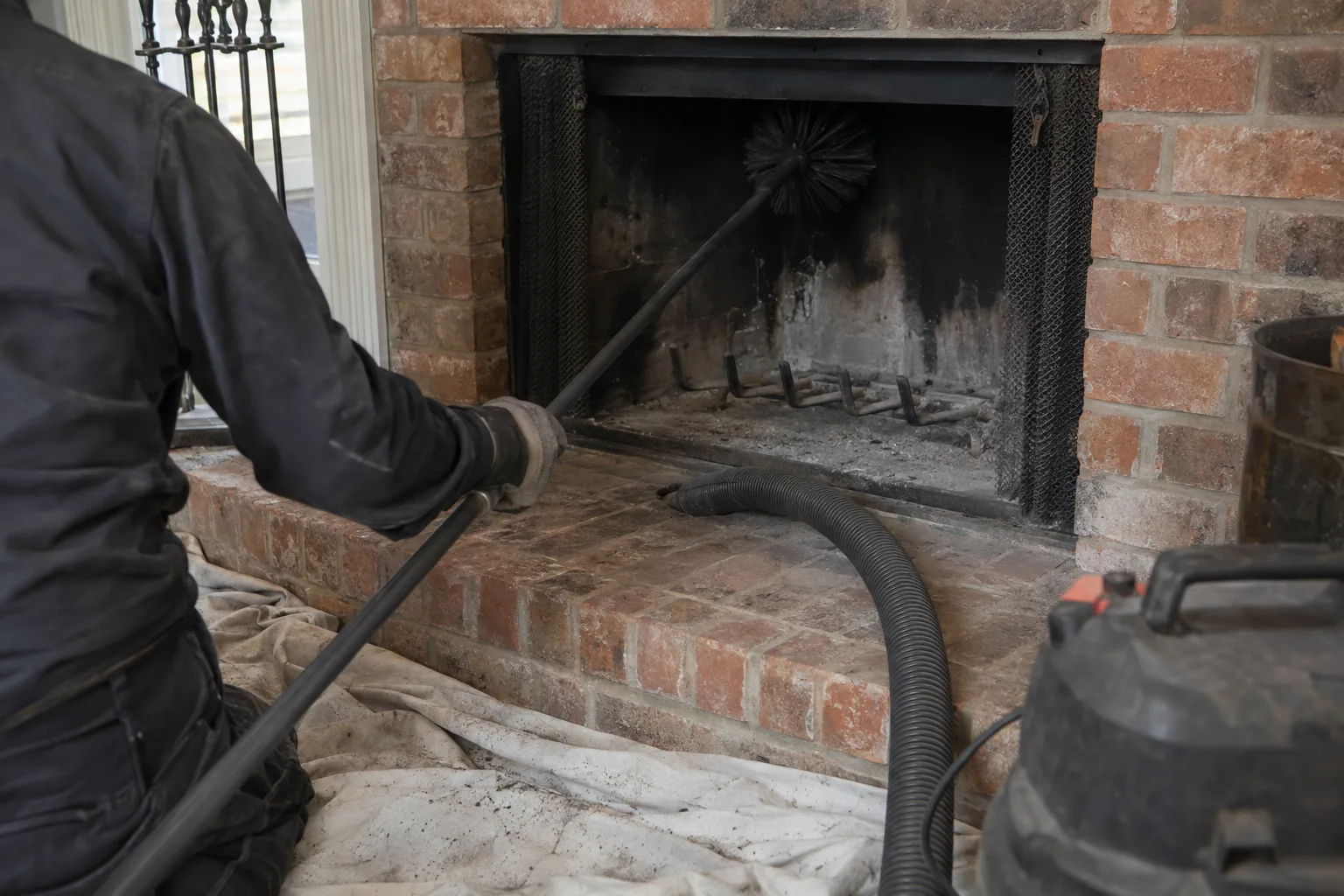
Inside, we set up dust containment at the firebox opening. This matters in Dallas homes, which tend to have open floor plans where dust travels quickly. We use commercial-grade HEPA equipment connected to the flue during brushing, which keeps soot out of your living room.
After brushing, a camera inspection of the liner shows us what brushing alone can't reveal. Cracked tiles, spalled liner sections, offset joints, and mortar gaps all show up clearly on camera. We walk you through the footage so you can see what we see. Read more on what camera findings in chimney flues actually mean.
Chimney Cap and Crown
Cracks, missing mortar, storm damage from Dallas summer hail
Masonry Exterior
Spalling brick, failed mortar joints, efflorescence from water intrusion
Flashing Seal
Gaps at the roof line where water enters during rain events
Liner Condition
Tile cracks, missing sections, creosote stage classification
Smoke Chamber and Damper
Proper sealing, warping, blockages, draft performance
Firebox Interior
Refractory panel condition, firebrick, mortar joints
Houston's Neighbor Problem
A chimney that hasn't had a fire in six months isn't necessarily a safe chimney. From June through September in Dallas, moisture from high-humidity air condenses inside the flue, especially at night when temperatures drop. Without a functioning chimney cap, rainwater also enters directly.
That moisture mixes with residual ash and sulfur compounds from past fires to form a weak acid solution. Over a Dallas summer, that solution seeps into mortar joints and slowly degrades them. The Chimney Safety Institute of America lists water as the leading cause of chimney deterioration, ahead of fire and heat damage. In Dallas, that concern is amplified by the season length.
Scheduling a fall inspection catches summer damage before you start burning again. If your chimney sat uncapped or with a damaged cap all summer, the inspection may reveal active leak damage or waterproofing needs before they become structural problems.
A good chimney cap installation in Dallas stops most of this. If you don't have one, or if the current cap is damaged, that's the first repair to prioritize.

Different Inspection Levels
Not all chimney inspections are equal. Understanding L1 vs L2 inspection scope helps you know what you're getting.
A Level 1 inspection covers all readily accessible areas of the chimney interior and exterior. It's what most annual cleanings include. A Level 2 is more thorough and uses camera equipment to examine areas not visible to the naked eye. The NFPA 211 standard requires a Level 2 any time you sell or buy a home, after a chimney fire, or after a significant weather event.
If you're buying a home in Dallas with an existing fireplace, always request a Level 2. The previous owners may have burned problem wood, or the liner may have unreported damage. Knowing the condition before you close protects you from expensive surprises. See our full guide on chimney inspection costs in Dallas.
Level 1 Inspection
Level 2 Inspection
Full Service Coverage
From the firebox floor to the cap on top, we handle every service in-house. No subcontracting, no referrals for jobs we don't do.
●
Annual cleaning for wood and gas systems. HEPA-equipped, camera-assisted, written report provided.
Sweeping cost guide →●
Tuckpointing, repointing, crown repair, and full rebuilds. Understanding which fix fits your damage saves money.
●
Clay tile repair and stainless steel relining. Choosing between clay and stainless depends on your system and budget.
●
Breathable sealant application to stop moisture intrusion without trapping vapor inside the masonry.
●
New cap installation, crown rebuilds, flashing repair. DIY flashing repair rarely holds in Dallas's climate.
●
Firebox repair, smoke chamber work, gas log installation, and outdoor fireplace builds.
Common Questions
No. The NFPA 211 standard calls for annual inspection of all wood-burning systems regardless of use frequency. Even a single fire can deposit Stage 2 creosote under the wrong conditions. More importantly, a year of Dallas humidity can produce moisture damage that has nothing to do with how many fires you lit.
Yes. Even a decorative gas appliance has a flue that connects to exterior air. Nesting animals, debris, and moisture still enter through that flue. Carbon monoxide from a blocked or deteriorating gas flue doesn't care whether the fireplace is decorative or functional.
September and October are ideal for wood-burning systems. You get the post-summer inspection that catches humidity damage, and you're cleared for the November-through-February burn season. For gas systems, spring works well, right after the burn season when technicians have more availability.
Stage 1 is flaky and gray. Stage 2 is darker, harder, and sticks to the liner surface. Stage 3 is shiny, tar-like, and sometimes drips. You can sometimes see Stage 2 or 3 by shining a flashlight up into the flue from the firebox opening, but a camera inspection gives a complete picture. After any chimney fire, assume Stage 3 until a professional confirms otherwise.
Brushing accessible sections is something some homeowners do, but it misses the inspection component entirely. You can remove surface soot without ever seeing a Stage 2 creosote deposit or a cracked liner tile. The cleaning is the easy part. The inspection is what prevents fires and carbon monoxide incidents. For a detailed look at what's involved, see our complete chimney sweep guide for Dallas.
Schedule a Level 2 inspection before lighting your first fire. Previous owners may not have maintained the chimney, may have burned green wood, or may have had a chimney fire that wasn't reported. A Level 2 gives you camera footage of the full liner so there are no surprises. Read about what to expect from masonry chimney repair in Dallas if the inspection turns up structural problems.
Dallas Service Area
Chimney inspections for Arlington homeowners.
Chimney rebuilds in Garland, TX.
Chimney leak repair in Southlake, TX.
Chimney rebuild services in Carrollton.
Chimney inspection for Denton properties.