

A missing or damaged chimney cap is one of the most common causes of water damage, animal intrusion, and accelerated masonry deterioration in Dallas-area homes. This guide covers exactly what to look for, what it costs, and when installation is genuinely worth it.
Safe Flue Chimney Sweep and Repair handles everything from routine annual sweeping to full chimney rebuilds across the Dallas area, including Garland, Carrollton, Arlington, and Denton.
Learn more about chimney repointing Dallas in Plano, TX →
Learn more about smoke chamber repair Dallas in Dallas, TX →
Most chimney problems in Dallas start small. A cracked crown, a missing cap, mortar joints worn down by summer heat cycles. Left alone, these minor issues let water in, and water is what destroys chimneys faster than anything else in North Texas.
We do not farm out work or send crews to jobs they are not trained for. Every technician we send to your home understands the full scope of chimney systems, from the firebox floor to the flue cap. That matters when we are diagnosing a problem that might look like one thing and turn out to be another.
Dallas weather is hard on chimneys specifically. Freeze-thaw cycles in winter, intense UV in summer, and the kind of heavy rainstorms that roll through every spring all stress the masonry. Dallas weather affects your chimney cap more than most homeowners realize, especially during storm season.
Ready to schedule?
Call us directly or request a quote for chimney cap installation in Dallas.
☎ (214) 441-6336Here is what to actually look for, and when a cap is the right call versus when another repair should come first.
If you find water pooling on the smoke shelf or see rust on your damper, there is a good chance rain is coming straight down the flue. A properly fitted cap covers the flue opening entirely and sheds water away from the liner and smoke chamber. Without one, every rain event soaks into your masonry from above.
The distinction worth making: if the water is entering at the roofline rather than down the flue itself, a cap will not fix it. That is a flashing repair issue, not a cap issue. We see homeowners install new caps when the actual source of moisture is failed step flashing around the chimney base. The inspection tells you which problem you actually have.
Learn more about how long chimney leak repair in Dallas takes once the correct problem is identified.
Chimney swifts, raccoons, and squirrels all nest inside uncapped flues in the Dallas area. You will usually hear scratching or chirping before you see any physical evidence. Birds and raccoons can build nests large enough to partially block draft and create a serious carbon monoxide risk.
A stainless steel cap with wire mesh stops entry completely. The mesh openings are typically sized at 5/8 inch to meet standard clearance requirements while blocking rodents and birds. Keep in mind that chimney swifts are federally protected, so if there is an active nest inside the flue, you need to wait until the birds have left before capping.
A bent lid, missing mesh panels, or visible rust through the base mean the cap is no longer doing its job. Galvanized steel caps typically last 5 to 10 years in the Texas climate before corrosion becomes a problem. Stainless steel caps last significantly longer.
If the cap was damaged in a storm, check whether the flue tile is cracked at the same time. A heavy impact that knocks off or dents a cap can also chip the liner just below the crown. A Level 2 chimney inspection will tell you definitively whether interior damage exists.
Leaves, twigs, and other debris falling into an open flue do more than create a mess. Organic debris accumulates on the smoke shelf and can ignite from stray sparks. This is a straightforward fire risk.
Dallas has enough trees around older neighborhoods that an uncapped chimney in fall will collect significant leaf buildup by the first fire of the season. A standard cap with mesh handles this completely. Before capping, have the flue swept clean so no debris is sealed inside.
If your chimney has a failed crown, a cap installation will not solve the water problem. The crown is the concrete or mortar cap that covers the top of the chimney structure itself, surrounding the flue. If it is cracked, water seeps into the masonry below the flue tile regardless of whether a flue cap is present.
Adding a cap on top of a failed crown is treating a symptom. The correct order is: repair the crown first, then install or re-install the cap. Chimney crown repair in Dallas typically needs curing time before capping, so this is usually a two-step process.
Similarly, if draft problems are your main complaint, the cap style matters as much as whether one is present. A standard flat cap can create downdraft in certain wind conditions. A multi-flue or vented cap with a specific directional design may be needed. This is worth discussing before purchase.
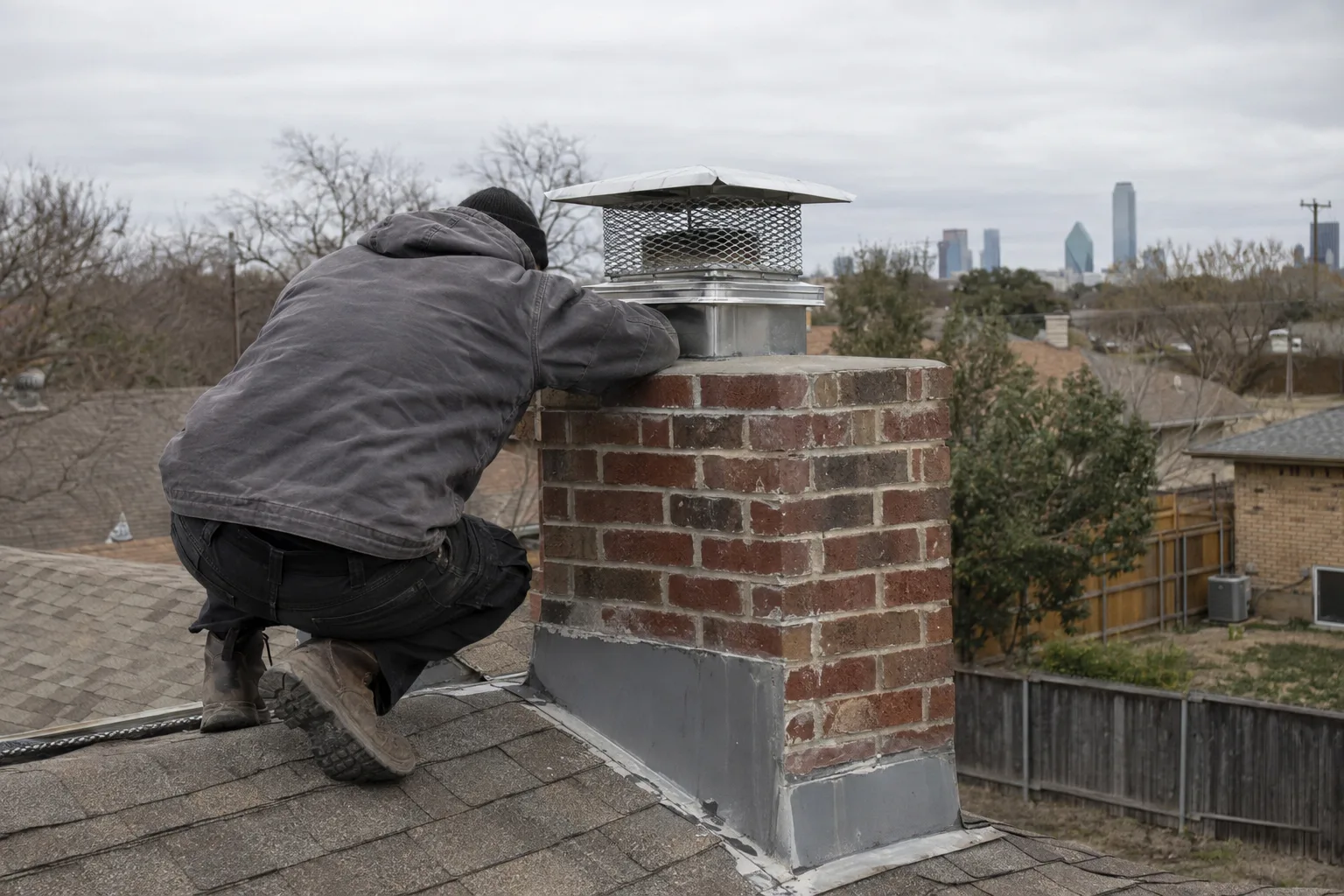
Cap installation itself is straightforward on most single-flue chimneys. A technician measures the flue tile opening, selects or fabricates a cap to match the dimensions, and secures it to the flue tile with stainless steel screws or a friction-fit adapter. Most jobs take under an hour on the roof.
The complication comes when the chimney has multiple flues, an oversized or non-standard opening, or deteriorated flue tile that needs repair before anything can be mounted to it. For a chimney with two or three flue openings, a full-width multi-flue cap that covers the entire crown perimeter may be the better choice, though these cost more.
For homes with existing masonry concerns, see our guide on what to expect during masonry chimney repair in Dallas before scheduling cap work.
Galvanized steel is the cheapest option and also the shortest-lived. The zinc coating degrades in direct Texas sun faster than in cooler climates. Expect 5 to 8 years before visible rust.
Stainless steel (304 or 316 grade) is the standard recommendation for longevity. It handles UV exposure, temperature swings, and the occasional hailstorm without corroding. Most quality stainless caps come with a lifetime warranty from the manufacturer.
Copper caps are the premium choice, developing a protective patina over time. They look good, hold up indefinitely, and cost significantly more. They are worth it on historic or high-end homes where aesthetics matter. For most Dallas homeowners, stainless is the practical answer.
A standard single-flue stainless steel cap installed in Dallas runs in a range tied mainly to chimney height and access. A one-story ranch with easy roof access is cheaper to service than a two-story with a steep pitch. Non-standard flue dimensions that require a custom-fabricated cap add cost.
Multi-flue caps that cover the entire crown can run considerably more, but they eliminate the need to service multiple individual caps and look cleaner on the roofline. If you are already paying for a sweep or inspection visit, ask about combining services. Travel and setup cost the same whether you are up there for one task or two.
For a broader look at what chimney work costs in this area, see our 2026 guide to chimney sweeping costs in Dallas.
Gas fireplaces still need caps, but the reasoning is slightly different. With a gas appliance, combustion products are mostly water vapor and carbon dioxide rather than creosote, so debris and animal blockage matter more than moisture accumulation in the liner. A blocked flue on a gas fireplace means exhaust is not exiting the house properly, which is a direct carbon monoxide hazard.
Annual gas chimney inspection in Dallas is the right baseline for any gas appliance. Cap condition is part of that inspection.
For guidance on maintenance frequency, see our breakdown of how often to clean a chimney for wood-burning vs gas fireplaces in Dallas.
Many caps double as spark arrestors, which is relevant for wood-burning fireplaces in Dallas. The wire mesh that keeps animals out also keeps burning embers in. During drought conditions, which are common in North Texas summers, a stray ember landing on a dry roof is a real risk.
The National Fire Protection Association and the Chimney Safety Institute of America both recommend spark-arresting caps as standard equipment on wood-burning chimneys. The mesh opening standard (5/8 inch) is designed to block sparks while maintaining adequate draft.
If you have never had your wood-burning fireplace swept and inspected, start there. A chimney sweep in Dallas should happen at least once a year for active wood-burning use, according to NFPA 211 recommendations.
Walk around the house and look at the top of the chimney. Visible cracks in the concrete crown mean that needs attention before or alongside a new cap. Skipping this step leads to continued leaks that get blamed on the new cap.
Binoculars from the ground can show whether the visible flue tile is cracked or spalling. A damaged tile at the top needs repair before mounting a cap to it. Otherwise the cap has nothing solid to anchor to.
Standard clay flue tiles come in specific dimensions, but older chimneys were built without standard sizing. A cap that does not fit the flue precisely will either not seal correctly or will be blown off in the first strong storm. Get the actual measurement before ordering anything.
A new cap alone does not waterproof the masonry below it. The brick and mortar joints are still porous, and Dallas rain, especially wind-driven rain, will penetrate the masonry face even with a cap in place. Chimney waterproofing is a separate treatment applied to the masonry surface.
The two steps work together, not independently. If you are already on the roof for a cap installation, it makes practical sense to waterproof at the same visit. See our detailed breakdown of chimney waterproofing costs in Dallas to budget for both.
Cap condition is checked as part of every Level 1 annual chimney inspection. If you are keeping up with annual service, a failing cap gets caught before it causes downstream damage. The cap is one of the first things a technician looks at from the roof because it is the most exposed component.
Not sure what level of inspection your situation calls for? See the breakdown of Level 1 vs Level 2 chimney inspections for Dallas homes. For a general overview, the 2026 chimney inspection cost guide for Dallas covers what each level includes.
Any chimney with an open flue benefits from a cap. The only exception is chimneys that have been permanently decommissioned and had the flue sealed at the top with a solid cover. If the flue is active or potentially reactivated, an open top is a liability for water, animals, and debris. There is no good reason to leave a working chimney uncapped in this climate.
The installation mechanics are simple, but working at roof height is where DIY chimney work goes wrong most often. Beyond the safety concern, an improperly sized or mounted cap that fails after a storm can damage the flue tile when it comes loose. If you are confident on a roof and can accurately measure the flue tile, a standard single-flue cap installation is achievable. Multi-flue caps, custom sizes, and anything involving deteriorated masonry at the crown are better left to a professional. See our article on common chimney repair mistakes Dallas homeowners make for context on when DIY tends to backfire.
A straightforward single-flue replacement runs 30 to 60 minutes on the roof once the technician is on site. If any crown repair, flue tile work, or custom fabrication is involved, the timeline extends. Combined visits where we sweep, inspect, and cap in one trip typically run 2 to 4 hours total for the whole job.
Cover the flue opening temporarily if you can do so safely from the roof, or close your damper tightly until a technician can get there. Rain entering an uncapped flue during an active storm can cause significant moisture damage in a single event. Call Safe Flue at (214) 441-6336 to schedule a post-storm inspection. We will check the crown and upper flue tile for storm damage before installing a replacement cap. For more on storm impact specifically, see the article on why Dallas summer storms matter for your chimney cap.
Cap replacement on an existing chimney does not typically require a permit in Dallas. New chimney construction or significant structural repair to the crown or flue may trigger permit requirements depending on the scope. If you are unsure about your specific project, ask when you call. We work throughout the Dallas area including Garland, Carrollton, Arlington, Denton, Flower Mound, Frisco, and surrounding communities. Check our service area pages including chimney inspection in Arlington, TX and chimney inspection in Denton, TX.
Safe Flue handles every part of the chimney, not just caps. If your chimney needs more than a cap, we do the sweep, the inspection, the liner repair, the masonry work, and the rebuild if it comes to that. You do not need to coordinate multiple contractors.
Call Safe Flue at (214) 441-6336 to schedule a cap inspection or installation. We serve Dallas and all surrounding DFW communities. Most cap jobs can be scheduled and completed within a few days of your call.
We check cap fit, mesh integrity, crown condition, and upper flue tile before recommending anything.
Single-flue, multi-flue, custom-sized, or full-cover caps. Stainless steel standard. Copper available.
Cap blown off? We inspect crown and liner for storm damage before installing the replacement.
Sweep, inspect, and cap in a single trip. Saves time and travel cost compared to scheduling separately.
© 2026 Safe Flue Chimney Sweep And Repair. Dallas, TX. All rights reserved.
Serving Dallas, Garland, Carrollton, Arlington, Denton, Frisco, and all DFW communities.